ELECTRIC UAV POWERTRAIN SIMULATOR

Power your quadcopter before you build it.

Model the full battery-to-propeller powertrain as one coupled system, and see thrust, efficiency, and endurance before you spend a dollar.

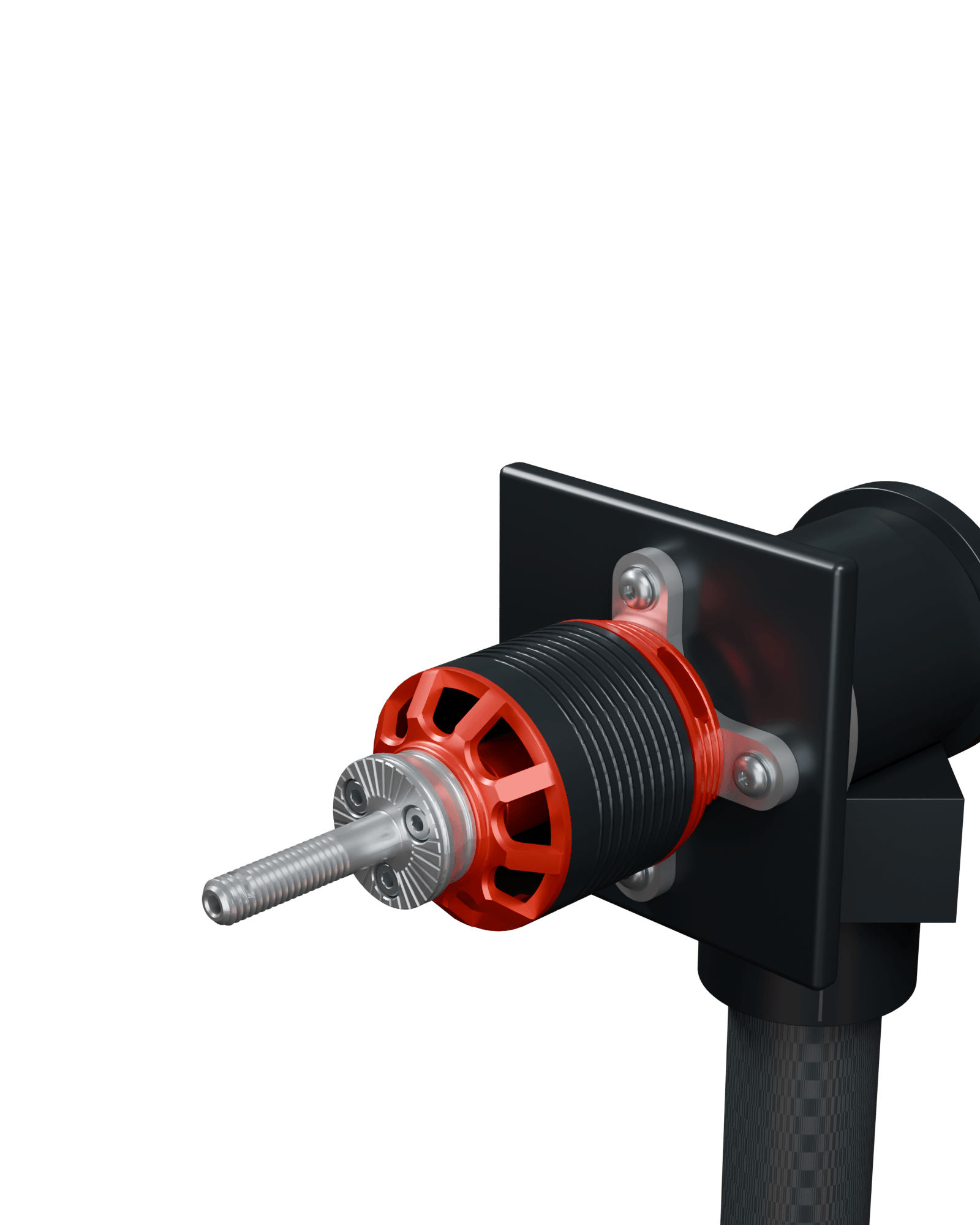
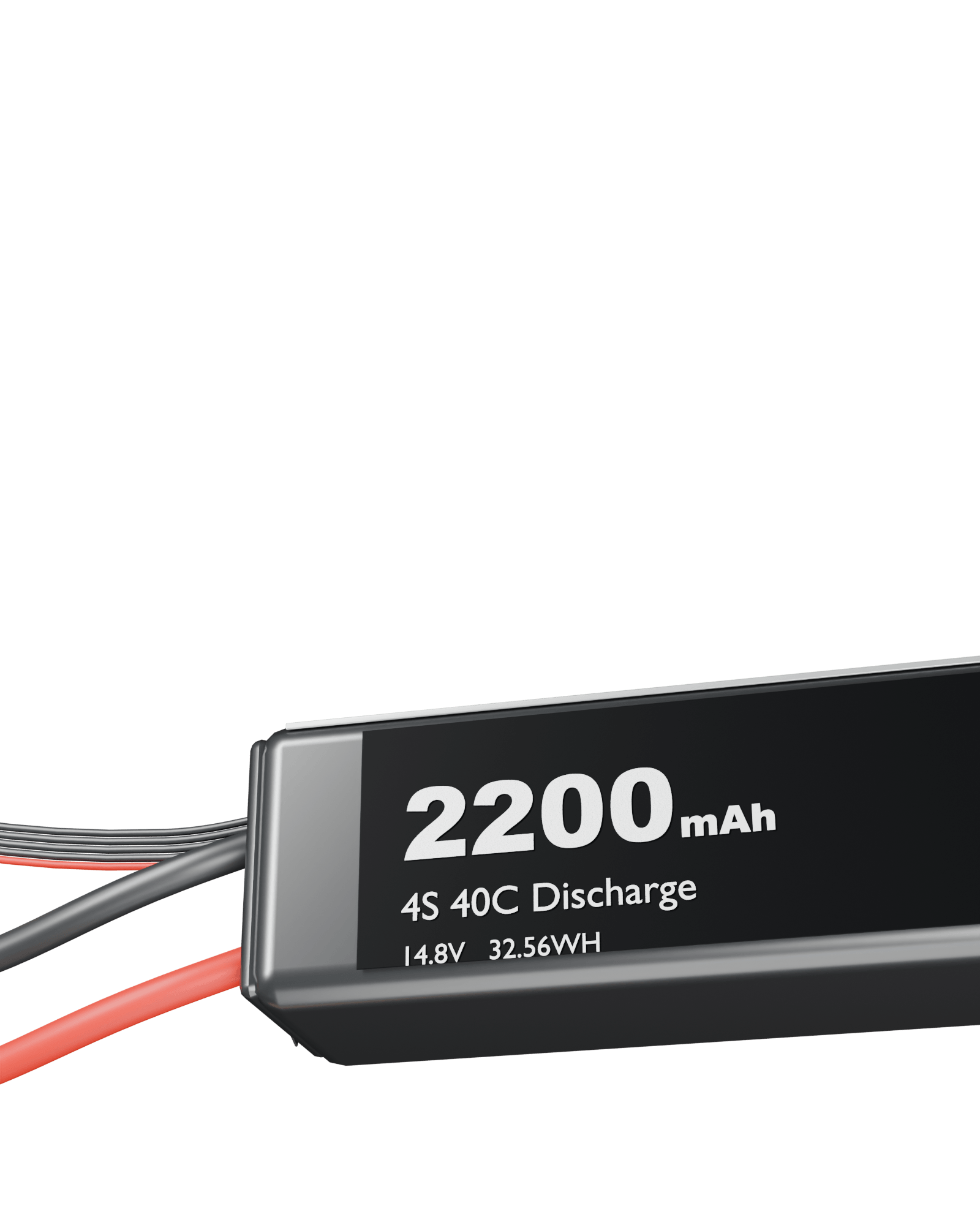
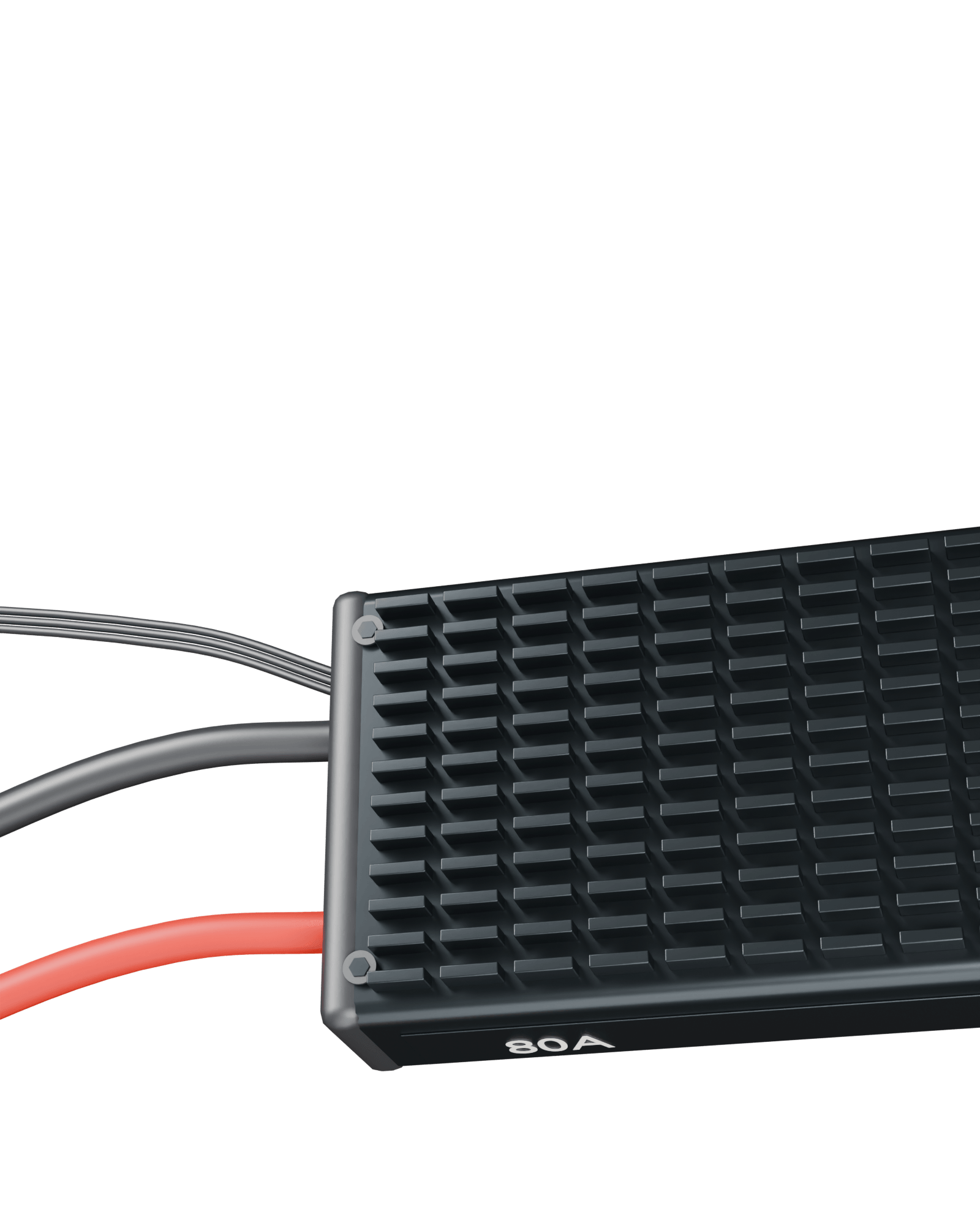
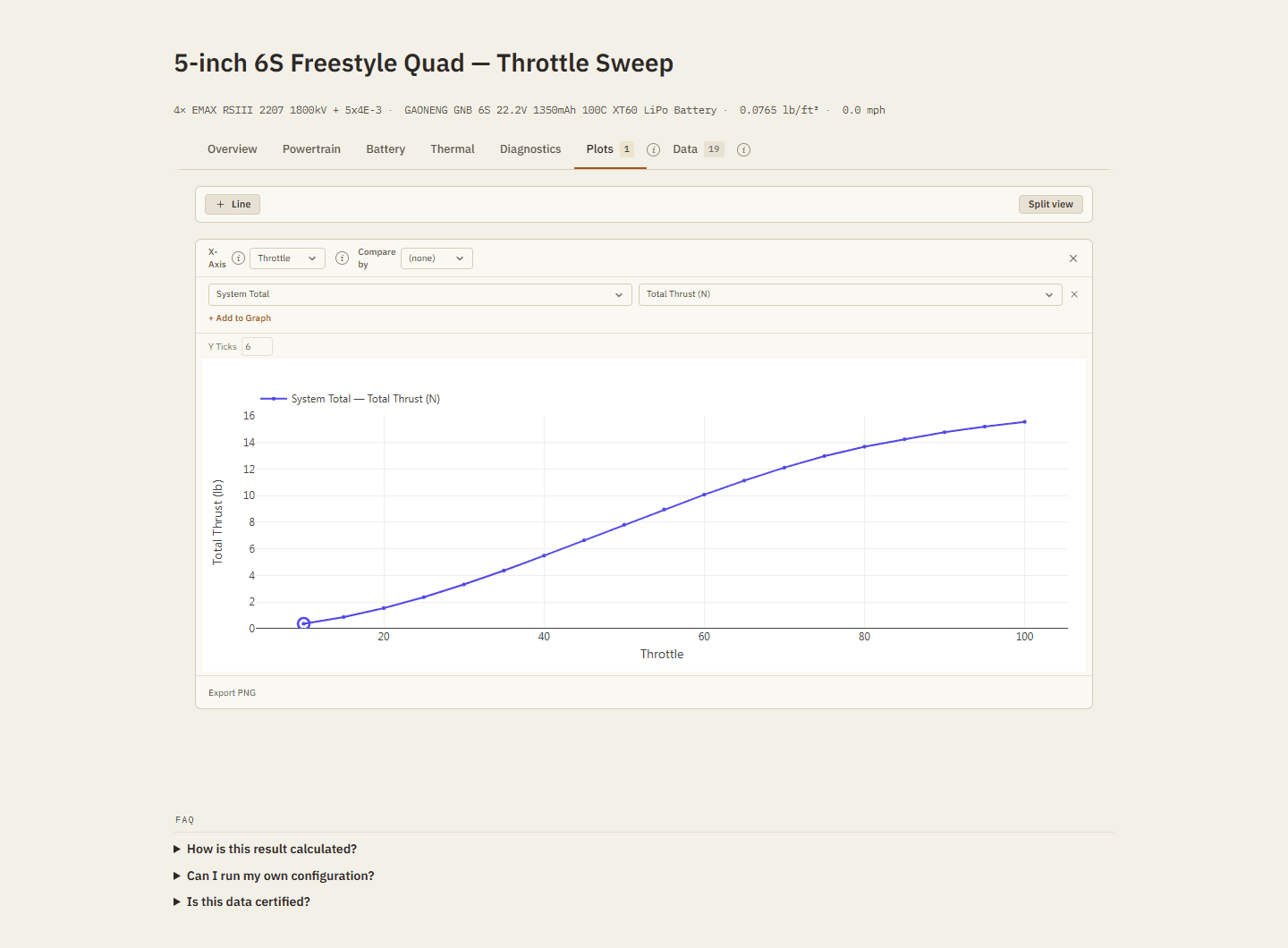
4× EMAX RSIII 2207 1800kV + 5x4E-3GAONENG GNB 6S 22.2V 1350mAh 100C XT60 LiPo Battery
converged
THROTTLE100%AIRSPEED0.0 mph
Total thrust7,054gf
Pack voltage18.2V
Pack current176.3A
η System68.4%
Endurance0.4 min
Total thrust vs Throttle sweep, 19 points

What ThrustLab does

One powertrain model. Three kinds of run.

Battery, ESC, motor, and propeller solve together as one coupled nonlinear system. Then you choose how to interrogate it.

Single point

Free

Set throttle, airspeed, and air density, and the solver converges the whole powertrain to one operating point: thrust, power, efficiency, currents, and temperatures, per rotor and system-wide.

will it hover, and with how much margin?

Sweep

Hobby+

Step throttle, airspeed, or density, or swap motors, props, and batteries, then chart the trade-offs as one family of curves. Single-axis on Hobby, multi-axis grids on Pro.

which prop wins across the whole envelope?

Dynamic mission

Pro

Fly a time-domain mission with throttle and airspeed ramps, motor and pack thermal coupling, and state-of-charge and cell-voltage cutoffs, scored in watt-hours and estimated range.

does the battery outlast the mission?

Where the watts go

Every watt accounted for.

Between the pack and the air, every stage takes its cut. The solver models each mechanism explicitly, since these losses are what decide your hover time.

Pack
  • voltage sag
  • internal resistance
  • cell heating
ESC
  • switching loss
  • conduction loss
Motor
  • copper I²R
  • iron: hysteresis + eddy
  • field weakening
Prop
  • induced power
  • profile drag
  • tip Mach effects
Thrust

what's left flies

What you get back

A full instrument readout, not a single number.

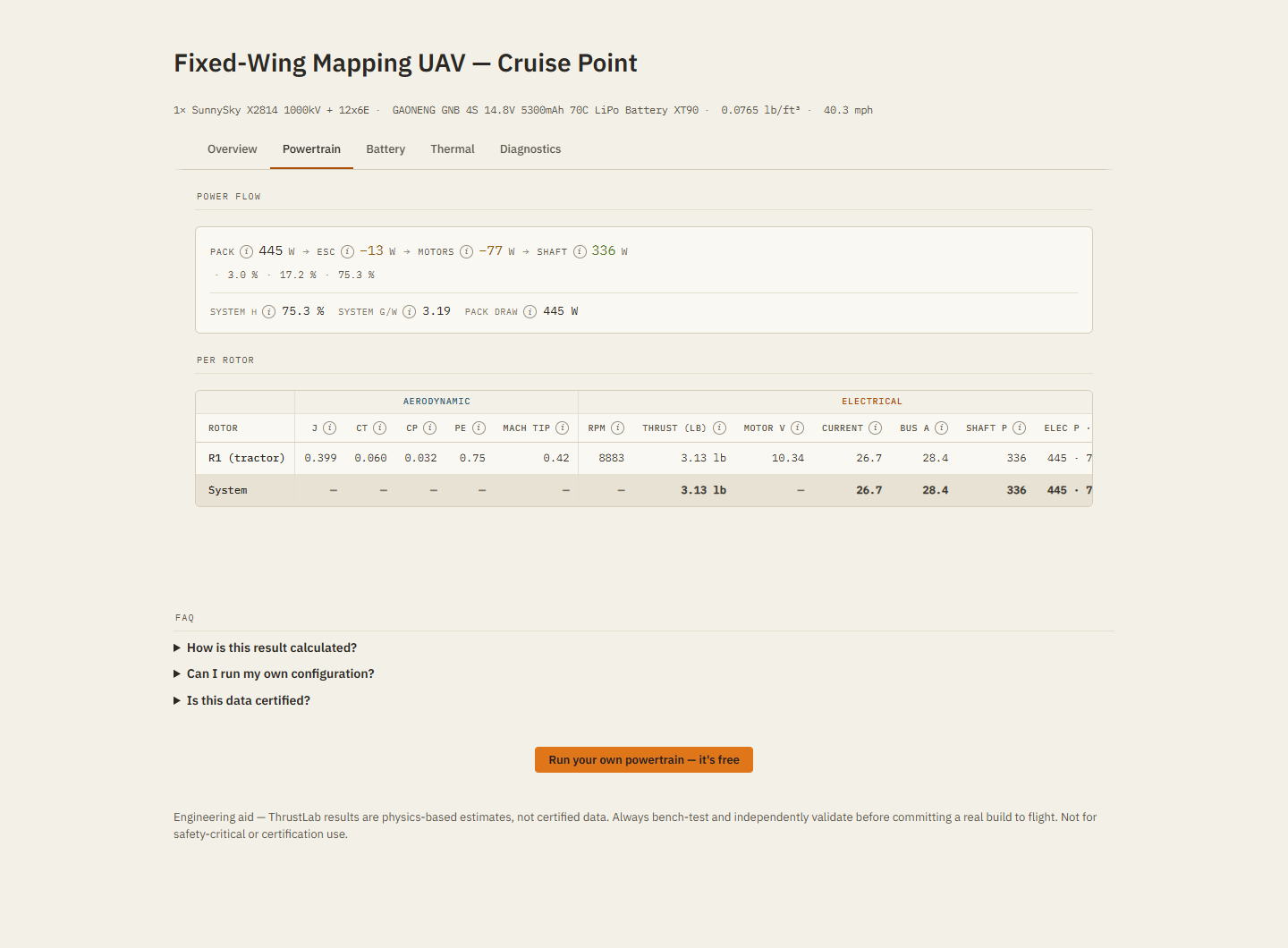
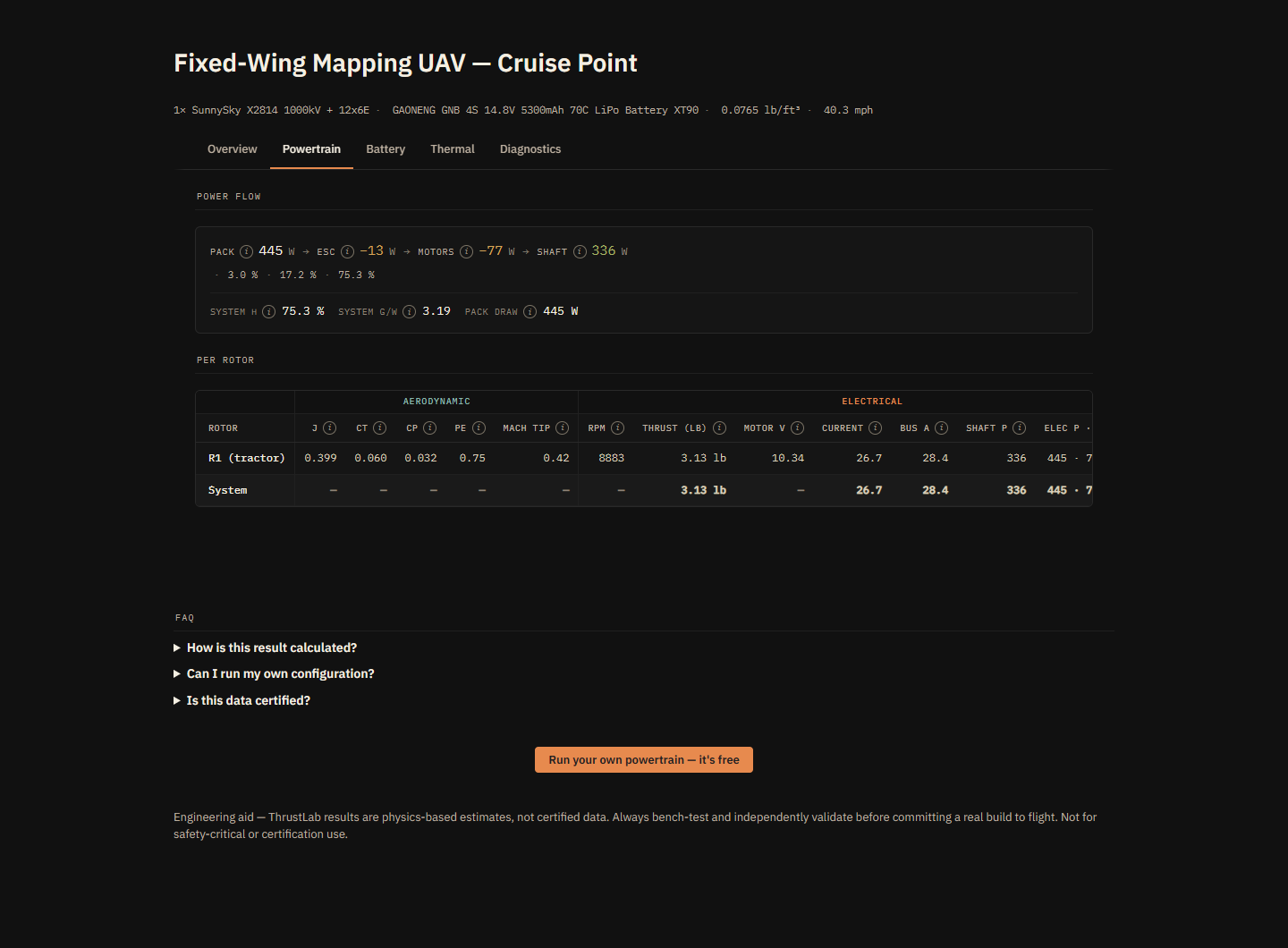
Every run returns the converged operating point across the whole powertrain, system-wide and per rotor, with the power-flow, thermal, and convergence detail behind it.

simulation_readout / fields

System

  • Total thrust (N)
  • Total power (W)
  • System efficiency (%)
  • Pack current (A)
  • g/W
  • Endurance

Per rotor

  • Thrust (N) & RPM
  • Current (A) & motor voltage (V)
  • Torque & shaft power (W)
  • Electrical power (W)
  • Efficiency (%)

Powertrain

  • Pack → ESC → motor → shaft flow
  • Advance ratio J
  • C_T & C_P
  • Tip Mach

Thermal

  • Winding temp (°C)
  • Magnet temp (°C)
  • Cooling-air velocity
  • Thermal resistance R_th
  • Convergence

Battery

  • Per-cell core temp (°C)
  • Per-cell case temp (°C)
  • State of charge
  • Pack thermal coupling

Dynamic mission

  • Full time series
  • Energy used (Wh)
  • Estimated range (km)
  • Stall / thermal / cutoff events

Field inventory across static, sweep, and mission runs; actual values populate when you run a simulation. Each run also reports convergence status, compressibility flags, and the solver version.

The wedge

Accurately model your exact powertrain.

When the catalog doesn't have your propeller, the self-serve creator builds it from a bench photo: scan the geometry, tune it (optional), simulate it, and export a clean STEP / IGES / STL body for CAD.

01Scan a photo
02Extract geometry
03Tune & simulate
04Export CAD

440+ curated propellers2,000+ curated motors2,000+ curated batteries

prop_geometry / created

APC 10×4.7 · scanned

from bench photo · 1,248 pts

diameter10.0 in
pitch4.7 in
blades2
station chords20

→ exported to STEP, IGES, STL

Beyond a single point

Built for the studies a calculator can't run.

Static operating points

Steady-state thrust, power, and efficiency at any operating point, with per-rotor and thermal detail. Included on the free tier.

Multi-rotor & mixed groups

Model mixed rotor groups, each with its own motor, propeller, throttle, ESC tune, and cooling mode, up to 16 rotors total.

Dynamic missionsPro

Fly a time-domain mission with throttle and airspeed ramps, state-of-charge and cell-voltage cutoffs, and a watt-hour and range scorecard.

Parameter & component sweepsHobby+

Sweep throttle, airspeed, or density, or swap motors, props, and batteries, then chart the trade-offs. Single-axis on Hobby, multi-axis on Pro.

Automation

Drive it from Python.

The same coupled solver, callable from a script. Create an API key on the Pro plan and run the whole study from your own code.

REST API

Every simulation type (static, sweep, dynamic) behind versioned /v1 endpoints.

Official SDK

pip install thrustlab: typed resources, pagination, webhooks, and a one-call wait().

Built for batch

Scripted trade studies, CI checks on a design, or a notebook full of what-ifs.

run_study.pypython · thrustlab sdk
$ pip install thrustlabfrom thrustlab import Clientclient = Client()  # reads $THRUSTLAB_API_KEYmotor = client.components.find(name="T-Motor F80")prop = client.components.find(name="APC 10x4.7")sim = client.simulations.create(    project_id=project["id"],    battery_component_id=pack["id"],    rotor_groups=[{"count": 4,                   "motor_component_id": motor["id"],                   "propeller_component_id": prop["id"],                   "throttle_pct": 70}],)result = client.simulations.wait(sim["id"])

Why it's accurate

Validated against the UIUC propeller wind-tunnel database.

ThrustLab's propeller solver runs blade-element-momentum theory over real blade geometry, checked against the UIUC propeller wind-tunnel database of 2,659 measured cases.

Read the methodology

methodology & curves are gated

Validation set

2,659

wind-tunnel cases

Thrust (C_T)R² 0.953MAE 0.0072
Power (C_P)R² 0.937MAE 0.0032

Thrust (C_T) and power (C_P) coefficients vs. measured UIUC data (Selig et al.). Engineering estimates, not certified data.

Who it's for

Built for the people who size propulsion.

In one line

ThrustLab is a physics-accurate electric-UAV powertrain simulator: it models the battery, ESC, motor, and propeller as one coupled nonlinear system, validated against the UIUC propeller wind-tunnel database, and includes a self-serve creator for propellers the curated catalog doesn't cover.

for UAV propulsion engineers and serious builders

Frequently asked

How is ThrustLab different from eCalc?
ThrustLab solves the whole powertrain as one coupled nonlinear system rather than chaining independent lookups, models dynamic and thermal behavior plus parameter sweeps, and lets you create propellers the catalog doesn't have.
How accurate is the propeller model?
Propeller aerodynamics are validated against the UIUC propeller wind-tunnel database across thousands of measured cases. The methodology and raw curves are available on the platform page.
What if my exact propeller isn't in the catalog?
Use the self-serve creator: scan a bench photo, extract the geometry, tune it (optional), simulate it, and export a STEP or IGES body for CAD.
Can I export geometry to CAD?
Yes, created propellers export to STEP and IGES for downstream CAD work.
Is there a free tier?
Yes. You can start free with no card; the free tier runs static simulations with a daily compute-unit allowance, and the paid tiers raise it to a larger weekly one.
Can I model a quad or other multi-rotor setup?
Yes. Configure mixed rotor groups (up to 16 rotors total), each with its own motor, propeller, throttle, and cooling, so asymmetric and mixed-rotor designs are modeled directly.
Is there an API?
Yes. On the Pro plan you get REST API access plus the official thrustlab Python SDK (pip install thrustlab): create an API key and drive ThrustLab programmatically for scripted runs and automation.
Is my simulation data private?
Your simulations stay private by default. You can choose to make an individual result public via a share link.

Run a simulation before you build it.

Free to start, no card required. The free tier includes a daily compute-unit allowance.

We use cookies and analytics tools to understand how you use ThrustLab and improve the experience. Privacy Policy

ThrustLab: Electric UAV Powertrain Simulation